
Before you spend anything on a new-build garden, find out what the builder or developer still owes you, then work in this order: clear the waste, set the levels, deal with compaction and drainage, bring in or spread proper topsoil, lay any patio or paths, and only then sow or turf and plant. Doing the pretty part first buries the problems under grass. Ask any contractor for a written quote that states topsoil depth, waste removal and whether VAT is included.
Three questions to answer before you spend
A new-build garden is rarely a blank canvas. It is a building site that has been tidied up to a point, and what happens next depends on three things you can find out for free.
- What did the sale agreement promise?
Look at the specification in your contract and the site layout. Does it say anything about topsoil, turf, boundaries or paths? You cannot ask for what the paperwork never mentioned, and you can insist on what it did.
- What is still outstanding?
List the garden problems with dated photos and send them to the developer in writing. A phone call leaves no record. Do this before anyone digs, because you cannot show a thin layer of topsoil once it has been mixed with your own.
- Who is responsible for the open ground around you?
In an estate, shared green areas, roads and drains belong to the developer or a management company until the council takes the estate in charge. That matters if a wet patch or a missing fence sits on the boundary rather than inside your garden.
Once you know what you can still ask for, the rest is a landscaping job. Our garden transformations work covers it from first levels to final planting, and it is explained below in the order the work should happen.
Who owes you what in Ireland
Most of the advice online about new-build gardens comes from the UK. It describes UK snagging codes, UK warranty bodies and UK ombudsmen, none of which apply to a house bought in Naas or Kilcullen. Three Irish points are worth checking instead.
- Your contract is the starting point. The Competition and Consumer Protection Commission (CCPC) advises getting the agreed price, the work to be done and the dates in writing for home improvement work. The same habit helps with a new house: whatever the developer said about the garden should be in your contract, not in a brochure.
- The HomeBond guarantee is structural cover for the building. The Oireachtas record describes HomeBond as providing structural defect insurance cover for new houses and notes that it is regulated by the Central Bank of Ireland. The Law Society has warned solicitors that the cover has many limitations. Whether anything outside the walls of your house is included is a question for your policy wording, so read it or ask HomeBond directly before you assume garden drainage is covered.
- Estates are taken in charge in stages. Kildare County Council has explained that before it assumes responsibility for an estate it carries out checks, such as CCTV surveys of foul and storm sewers and manhole surveys, and the consultation notices list roads, footpaths, public lights, open spaces and surface water systems as the things being taken in charge. Until that happens, ask your management company or developer who maintains the green areas next to you.
The order to fix it in
This is the sequence a sensible job follows. Each step depends on the one before it, so skipping ahead means redoing work.
| Step | What happens | Ask or check first |
|---|---|---|
| 1. Paperwork | Read the contract spec and send a written, photographed list of garden snags | What did the developer promise, and what is still outstanding? |
| 2. Walk the site | Note heaps, buried offcuts, hard patches, wet spots and manholes after a rainy day | Where does water sit, and where does it run? |
| 3. Clear | Remove rubble, plastic, offcuts and cement left in or on the ground | Who takes it away, and is the skip or lorry in the quote? |
| 4. Levels | Shape the ground so water falls away from the house and boundaries | Where is the damp-proof course, and how much ground is above it? |
| 5. Compaction and drainage | Break up compacted ground and add drainage where tests show it is needed | Has anyone dug a test hole to look at the soil layers? |
| 6. Topsoil | Spread a measured depth of clean topsoil over the prepared ground | What depth, and where is the soil coming from? |
| 7. Hard landscaping | Patio, paths, edging and any raised beds | Is the base specified, and is VAT included? |
| 8. Lawn, then planting | Sow or turf, then borders, shrubs and hedging | Is it the right season for seed? |
Boundaries fit best between steps four and six, before the lawn and planting go in and while a machine can still get through. A fence line is also a good moment to check with your solicitor or your site map exactly where your boundary runs. Our fencing and decking page covers the choices.
Compaction and drainage: what to look for
New-build sites are worked by heavy machines, and the ground under the topsoil is often squeezed hard. Teagasc describes soil compaction as the squashing together of soil aggregates, which cuts the number of large pores that water and air move through. The result it lists is waterlogging or surface runoff, which is exactly the standing water many new-build owners see after rain.
The fix depends on the cause, and Teagasc's Heavy Soils Programme, which works on poorly drained farmland, makes the same point: diagnose first. Its approach starts with digging test pits to look at the soil layers and see where water seeps before choosing a drain type. A garden is smaller than a farm field, but the logic holds. A landscaper who recommends land drains, gravel or a soakaway before looking at the soil is guessing.
Three practical points follow from that:
- Test holes are cheap. A few holes after wet weather show you whether there is clay close to the surface, rubble below it or a hard layer that water cannot get through.
- Rubble in the ground makes drains unpredictable. Voids and lumps of block change where water goes. It is better removed than built over.
- Do not work wet clay. Digging or driving over saturated clay smears and compacts it further. A good contractor waits for drier weather or uses lighter machines.
Topsoil: a worked sum
Topsoil is bought by volume, and the volume is area multiplied by depth. Take a back garden with 120 m² to be grassed. The table shows how the amount changes with depth. These are quantities, not prices.
| Depth spread | Sum | Volume |
|---|---|---|
| 75 mm | 120 m² x 0.075 m | 9 m³ |
| 100 mm | 120 m² x 0.100 m | 12 m³ |
| 150 mm | 120 m² x 0.150 m | 18 m³ |
If the developer left 75 mm and you want 150 mm, the shortfall is 18 m³ minus 9 m³, which is 9 m³ of soil to bring in. That is why you measure the existing depth with a spade in several places before you ask for quotes. Without the depth, two quotes for "topsoil" can differ by thousands of euro and still describe different jobs. The same point is made in our guide to the garden after an extension, where the 60 m² version of this sum appears.
Garden left as clay and rubble?
Have Seanie look at the ground first
He will check the levels and soil, agree what is included and put the price in writing, so you can compare quotes like for like.
Request a free quoteCall 087 355 4302Patio and paths before the lawn
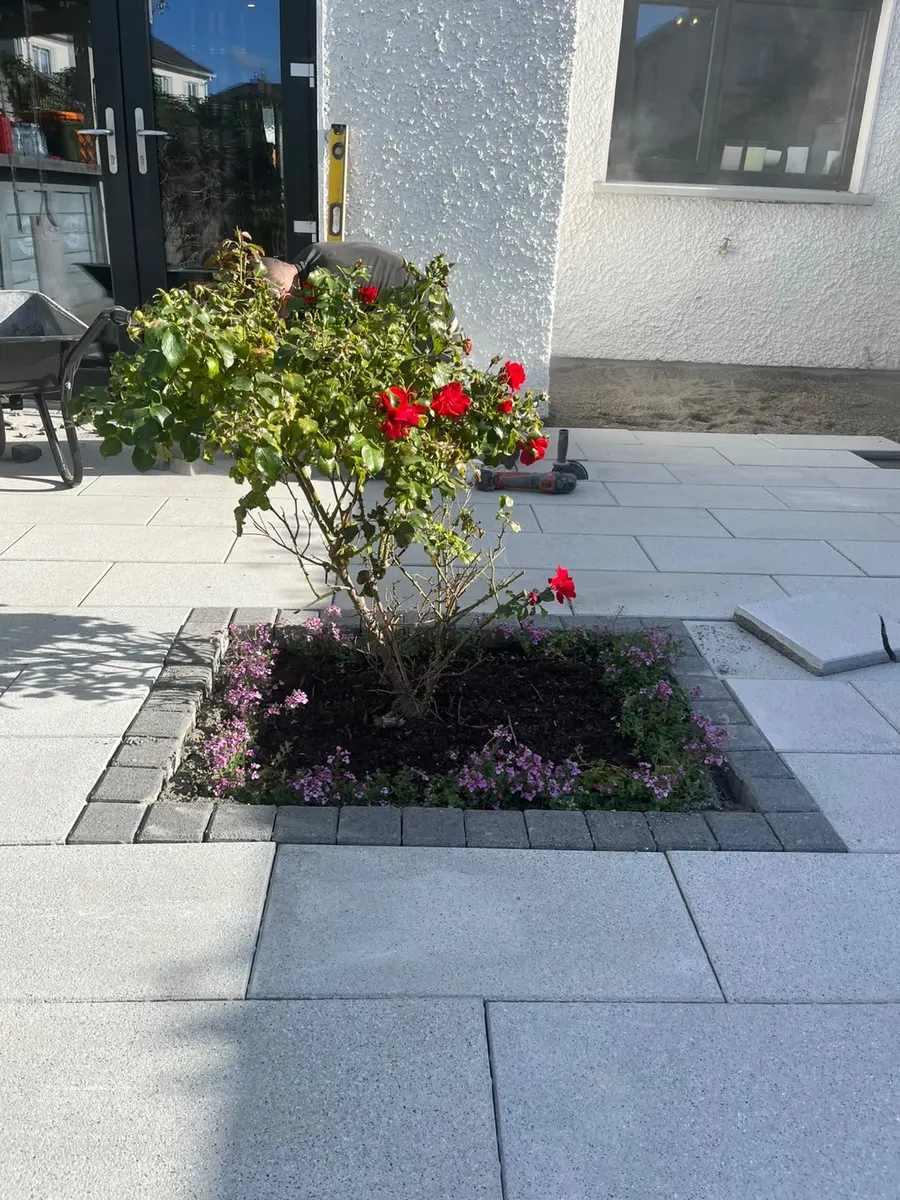
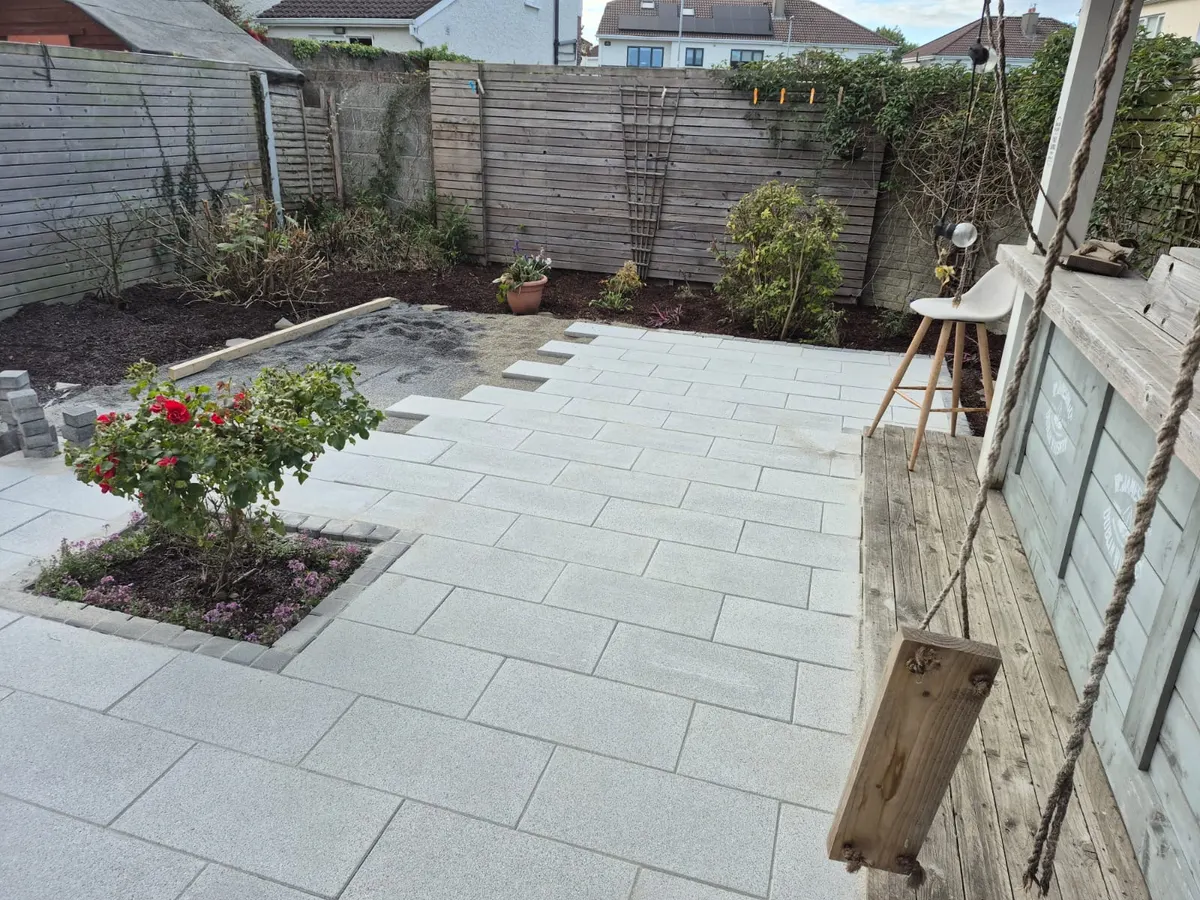
If you want a patio, lay it before the lawn goes down. The base needs digging out and compacting, and that is much easier on bare ground than on new grass. It also lets you set the final levels of the lawn against a fixed edge. The photo below shows a finished porcelain patio from one of our jobs, with a rose bed set into it. It is not a new-build garden, and it is here only to show what a hard surface finished against a planted bed looks like.
Costs differ widely by material and base, and the VAT position matters. Our patio cost guide works the sums through, and the patios and paving page explains how the job is run.
Lawn and planting: timing
If you are reading this in October, the sowing season has mostly passed. Teagasc's advice on autumn reseeding of grassland says timing is crucial and puts the cut-off for autumn sowing at about the start of September, because cooling soil slows germination. A lawn is not a farm sward, but the same soil temperature logic applies. For a new-build garden finished now, that leaves two sensible choices: lay turf for immediate cover, or have the ground prepared over the winter and sow in spring.
Preparing in winter is not lost time. It is the part that decides whether the lawn lasts. If a hedge is part of your plan, plant it early and read our notes on hedge cutting and tree work to understand the upkeep.
VAT: make the quote say it
Revenue lists landscaping work on a private dwelling at the reduced VAT rate, currently 13.5%, where the contractor is VAT registered. A price shown without VAT is not what you will pay. This is only an illustration of the arithmetic. It is not a price for any job and not a Kildare Plant & Garden price.
| Line | Amount |
|---|---|
| Quote before VAT (illustration) | €6,000 |
| VAT at 13.5% (€6,000 x 0.135) | €810 |
| Total you pay | €6,810 |
The CCPC advises traders to give a price that includes VAT, or to say how it will be calculated if the final figure cannot be known in advance. Ask which one you have been given. Our guide to nine questions to ask a landscaper covers the rest of what to get in writing.
What a fair quote lists
A new-build garden is easy to under-quote because the biggest costs sit underground. Make sure these lines are on the page before you compare totals:
- Clearance and waste
What is being removed, who takes it, and whether the skip or lorry and disposal are in the price.
- Levels
What regrading is included, and how water will be directed away from the house and boundaries.
- Compaction and drainage
What is being done to the ground, and what is deliberately left out until a test hole is dug.
- Topsoil
The depth, the volume and where it comes from, as in the table above.
- Hard surfaces and boundaries
Base depth, edging and finish for any patio or path, and whether fencing is part of this quote.
- Lawn and planting
Seed or turf, and whether borders and plants are in this stage or a later one.
- VAT and payment
The total with VAT, the stages and what you will have seen done before each payment.
- Surprises
How buried rubble, soft ground or a hidden pipe will be handled: told to you, priced and agreed in writing before work goes ahead.
If a quote does not mention waste, topsoil depth or VAT, it is lower on paper because those costs have been left out. They do not go away. They arrive later as extras.
What changes the answer
- How much is still the developer's job. If the contract promised topsoil and turf, part of this may not be yours to pay for.
- Access. A wide side gate lets a small machine in. A narrow terrace means hand work and a longer job.
- The soil underneath. Heavy clay holds water, and a test hole tells you more than a photo.
- What is buried. Clean soil in a heap is an asset. Mixed rubble is a cost.
- The season. Groundworks in a wet autumn run slower, and a good quote allows for it.
- What you want at the end. A plain lawn is the base. Paving, fencing or full planting changes the scope and is best planned together so the same machine sets the levels once.
What to send for a fixed quote
Photos of the whole garden from the house and back towards it, the rough size, where the side access is and a photo of any heaps or wet patches. Add what your contract says about the garden, if it says anything. With those, Seanie can say what a visit needs to check before a written price. For larger projects that include planting and hard landscaping, the garden transformations page explains how the stages fit together, and landscaping and groundworks covers the preparation.
How Kildare Plant & Garden handles it
Seanie runs Kildare Plant & Garden Solutions from Kilcullen and works across Kilcullen, Naas, Newbridge and the rest of County Kildare. For a garden like this he starts with a site visit rather than a price over the phone, looking at levels, drainage and access, then sends a written quotation that sets out what is included. The business is set up for groundworks and machinery-supported jobs, so clearance and regrading can be planned with the finish. Once the garden is established, our garden maintenance prices guide explains what regular care costs and the garden maintenance page shows how visits work. To start, send Seanie photos of the garden.
New-build gardens: common questions
What should I do first in a new-build garden?
Find out what the developer still owes you, then send a written, photographed snag list. After that the order is clear waste, set levels, fix compaction and drainage, spread topsoil, lay any patio, then sow or turf and plant.
Is the developer responsible for my garden?
Only for what your contract says. Check the specification for topsoil, turf, boundaries and paths, and raise anything missing in writing. If you are unsure, ask your solicitor.
Does HomeBond cover garden drainage?
HomeBond is described as structural defect insurance for new houses, and the Law Society notes its cover has many limitations. Whether anything outside the house is included depends on your policy wording, so read it or ask HomeBond.
Why does my new-build lawn stay waterlogged?
Often because the ground was compacted by machinery, which Teagasc says reduces the large pores water moves through and can cause waterlogging or runoff. Rubble or clay close to the surface can also be the cause. Dig test holes after rain before choosing a fix.
How much topsoil does a new garden need?
Multiply the area by the depth. For 120 m², 100 mm is 12 m³ and 150 mm is 18 m³. Measure what is already there and ask for the depth and volume in every quote.
Can I sow a lawn now in October?
Teagasc puts the cut-off for autumn sowing of grassland at about the start of September. For a garden finished now, laying turf or preparing the ground over winter and sowing in spring are the usual choices.
Is VAT charged on landscaping a new garden?
Yes, where the contractor is VAT registered. Revenue lists landscaping for private dwellings at the reduced rate, currently 13.5%. Ask whether each quote includes it.
What does Kildare Plant & Garden charge for a new-build garden?
Seanie does not publish a price for this. He looks at the site, agrees what is wanted and puts the price and what it includes in writing. The quotation is free, subject to the project and location.
Sources
Sources checked on 19 October 2026.
- Revenue: VAT rate for landscaping (private dwellings).
- CCPC: Home improvement and building work disputes, on written details and payment.
- Teagasc: Soil structural degradation, on compaction.
- Teagasc: Heavy Soils Programme update (Kildalton, 2018), on diagnosing drainage before choosing a system.
- Teagasc: Autumn reseeding, timing is crucial.
- Kildare County Council: Taking in charge of roads and services.
- Law Society of Ireland: HomeBond practice note.
- Oireachtas: Dáil question on HomeBond (16 June 2016), on its regulation by the Central Bank.