
The builders have gone, the extension is finished, and the garden is rubble, compacted clay and mud. The order that works is to clear the waste first, set the levels second, deal with drainage while the ground is still open, and only then spread topsoil and sow or turf. Burying rubble to save a skip is the shortcut that causes the most trouble later, and a quote for the job should say in writing who removes the waste, how deep the topsoil is and whether VAT is in the price.
Why the garden ends up like this
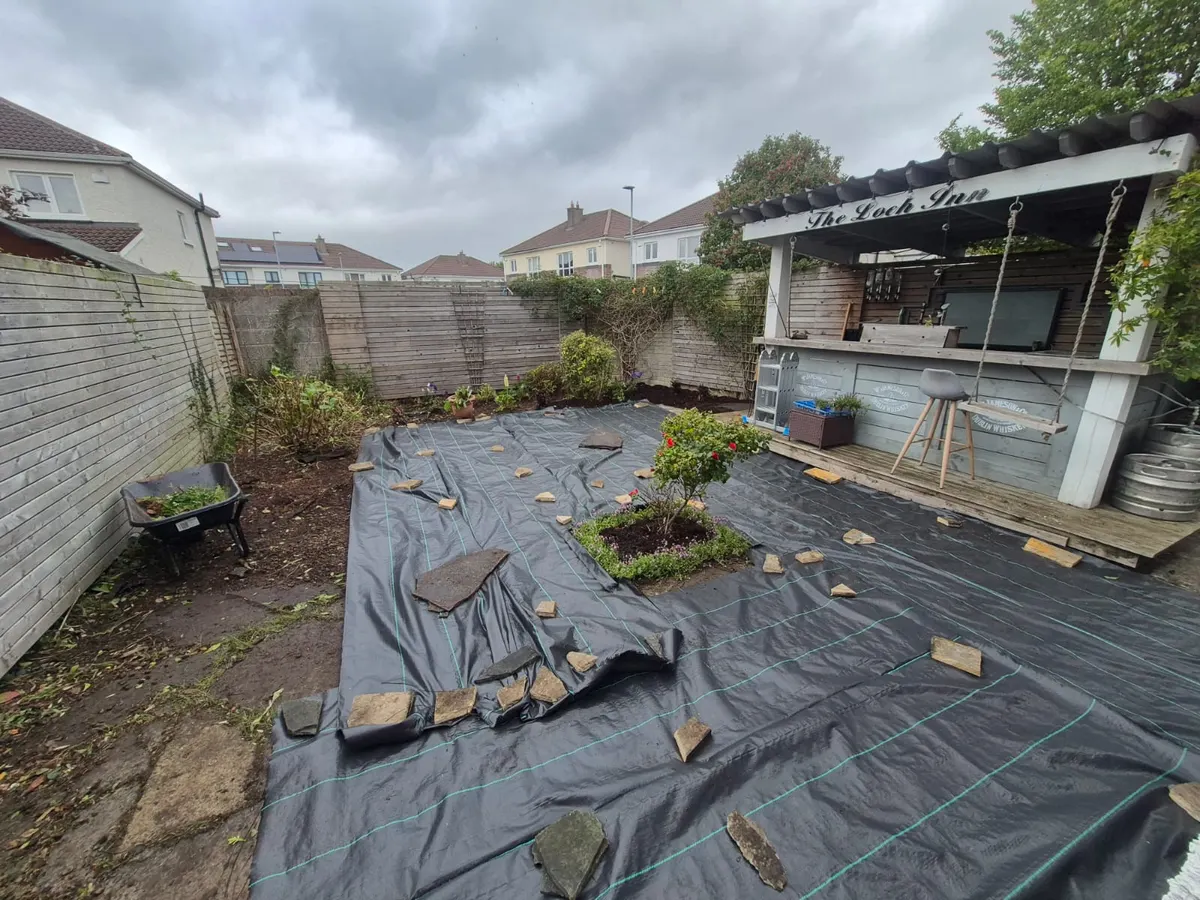
An extension is a heavy job on a small site. Diggers, dumpers, deliveries and a skip all work across the back garden, and the lawn is usually the place where everything gets stacked. By the end the ground is often compacted, the topsoil is mixed with subsoil and brick, and offcuts, sand and cement have been left in heaps or raked in. None of that is unusual, and none of it is a sign of bad work on the extension itself. It is simply that the building job ends at the wall and the garden is a separate job.
That matters for who pays. Check your building contract before you assume the garden is part of it. If the builder was never asked to reinstate the garden, the clearance and regrading are a landscaping job, and it helps to treat them as one. Our landscaping and groundworks work covers exactly this stage: clearing, levels, drainage and preparation, with machinery where the job needs it.
The order to do it in
Most mistakes come from doing the nice part first. Spreading topsoil over a bumpy, rubble-filled site just hides the problem for one season. This is the sequence a sensible job follows, and why each step comes where it does.
| Step | What happens | Why it comes here |
|---|---|---|
| 1. Survey | Walk the garden, note heaps, hard areas, manholes, wet spots and where water runs | You cannot price or plan what you have not seen |
| 2. Clear | Remove rubble, offcuts, sand and cement, and strip any hard-packed areas | Levels depend on how much soil is left once the waste is gone |
| 3. Sort the soil | Keep good topsoil apart from subsoil and made ground | Mixed soil is the cause of poor lawns and patchy borders |
| 4. Set levels | Shape the ground so water falls away from the house and nowhere is left as a dip | Drainage and lawn finish both depend on it |
| 5. Drainage | Break up compaction, add land drains, gravel or a soakaway where the ground needs it | It is far cheaper while the ground is open than after the lawn is in |
| 6. Topsoil | Spread and lightly firm a measured depth of clean topsoil | It sits on a prepared base, not on rubble |
| 7. Seed or turf, then planting | Sow or lay turf, then add borders and planting | Last, so nothing is walked over or dug up again |
Rubble: why you should not bury it
It is tempting to dig a hole and bury offcuts, broken blocks and spare hardcore. Gardeners who have inherited that kind of fill describe the same problems: voids between the pieces, soil slumping into them over time, and a lawn that dips years later. Rubble also holds water unpredictably, so one patch stays waterlogged while the next dries out. If any building material is used as fill, it needs to be broken up, spread evenly and covered with a proper depth of soil. For most gardens it is better to take it away.
Whatever you remove should be removed properly:
- Waste leaves the site with a permitted collector. Kildare County Council says that anyone collecting waste in the county needs a waste collection permit, and that the Council does not provide skips or collect builders' rubble from community clean-ups. Ask whoever supplies the skip or lorry for their permit details, and ask where the load is going. The destination also needs a waste permit or to be planning exempt, as the Council's waste facility permit page explains.
- Clean soil may not count as waste. The EPA's national by-product criteria for greenfield soil and stone (BP-N002/2024) let clean greenfield soil and stone qualify as a by-product by showing it meets the criteria, without waiting for an individual determination. Soil that is mixed with brick, plastic or cement is a different matter. Ask what will happen to the soil that comes out, and do not assume it can be tipped anywhere.
- Treat suspect fragments with care. If you find broken sheets or pieces of cement-type material that could contain asbestos, do not break, cut or sweep them. Irish environmental guidance says damaged material should be removed, that a specialist contractor is needed for significant amounts of asbestos cement, and that disposal goes through the local authority or a permit holder. It does not go in a household bin or a skip.
Levels: where the water goes
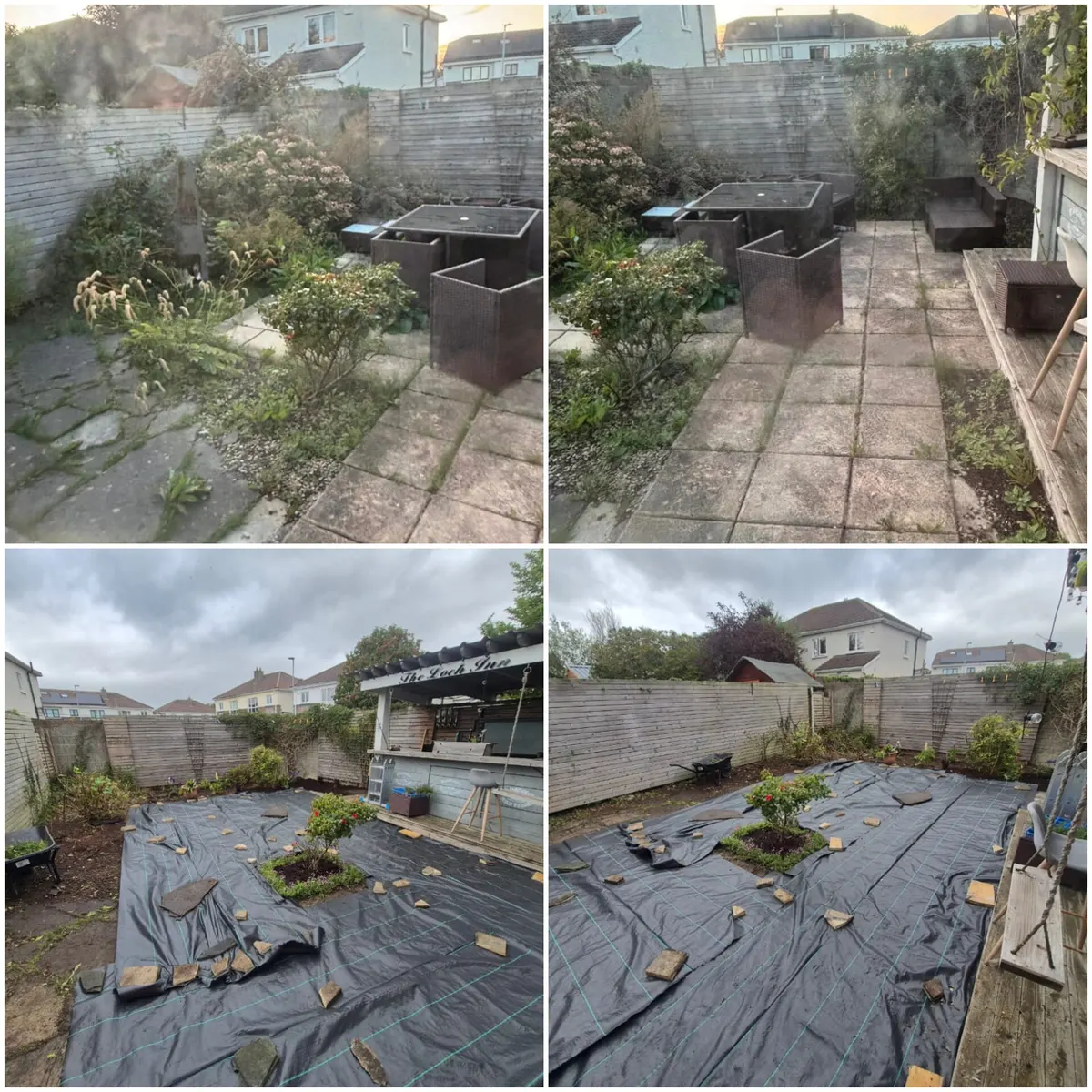
Levels are the part you cannot easily change once the lawn is down. The ground should fall gently away from the house and the new extension walls, with no shallow dishes where water can sit. After building work, some of the garden is usually lower than it was and some higher, because of spoil, and the extension itself may have changed where the roof water goes.
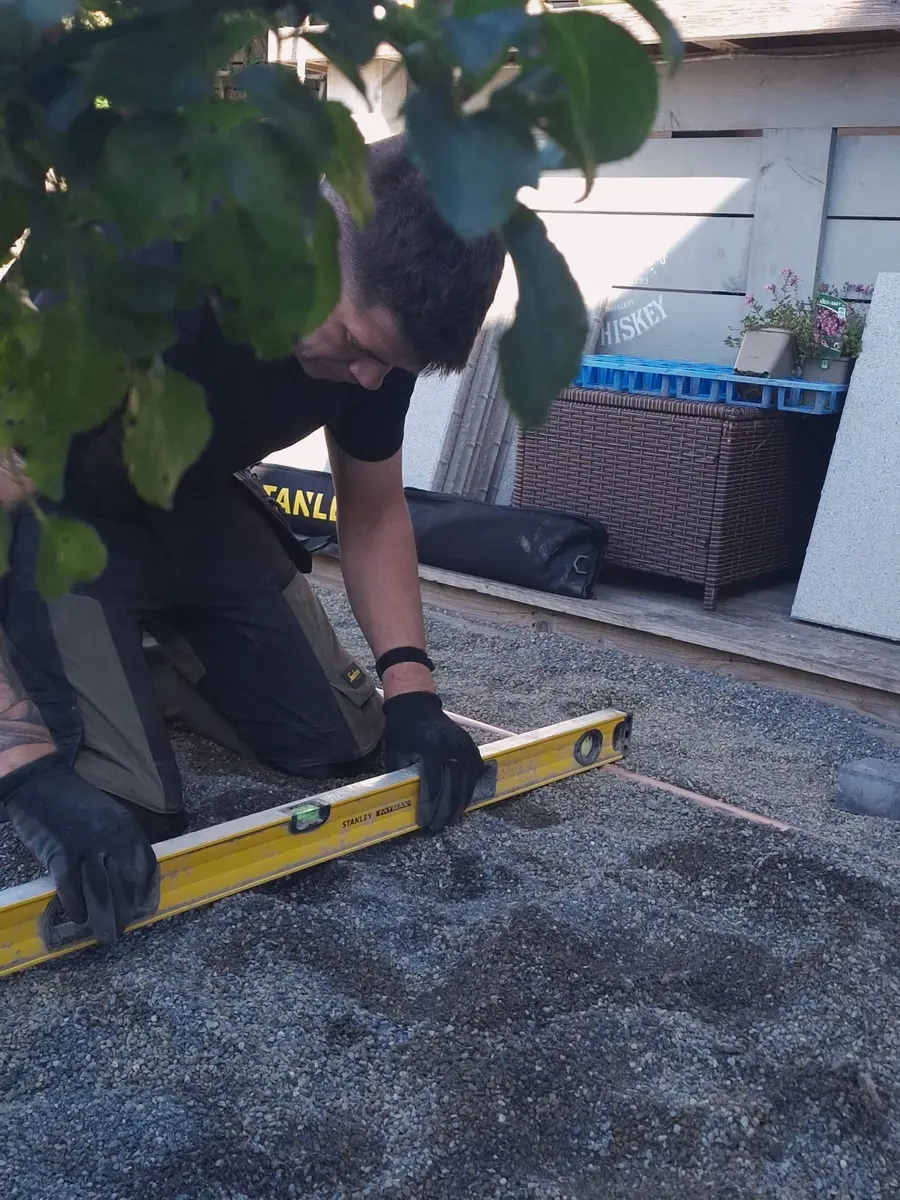
A landscaper sets the levels with string lines, pegs and a level, then checks them again before topsoil goes on. The photo below is from one of our patio jobs and shows the same discipline on a smaller scale: a screeded bed marked out with string lines and checked with a spirit level before anything is laid. A lawn is more forgiving than paving, but the principle is the same. Measure first, then fill.
Drainage while the ground is open
The extension's own drains are covered by the Building Regulations. Technical Guidance Document H (drainage and waste water disposal) is the document the Department of Housing publishes for this, and the 2016 edition is the current one on gov.ie. Your builder and your building control records should show where the new drains and any manholes run. Ask for that layout before anyone digs, so the garden work does not cut or crush a pipe.
The garden's surface water is a separate question. Compacted clay, filled ground and a low corner are the usual reasons for a waterlogged lawn after building work. The options are generally to break up the compaction, regrade so water has somewhere to go, add gravel or land drainage, or in some cases a soakaway. Which is right depends on the soil and the site. A landscaper who suggests one before seeing the garden is guessing, and a site visit comes before a price.
Do this at step five, before the topsoil goes on. Trenches are quick to dig in open ground and expensive to dig through a finished lawn.
Topsoil: worked sum
Topsoil is sold and quoted by volume, and the volume is simple arithmetic: area in square metres multiplied by depth in metres. This is a worked example for a garden area of 60 m², to show how depth changes the quantity. It is not a price.
| Depth spread | Sum | Volume |
|---|---|---|
| 75 mm | 60 m² x 0.075 m | 4.5 m³ |
| 100 mm | 60 m² x 0.100 m | 6.0 m³ |
| 150 mm | 60 m² x 0.150 m | 9.0 m³ |
Going from 100 mm to 150 mm adds half as much soil again, 3 m³ on a garden this size. That is why a quote that says "topsoil" with no depth cannot be compared with one that says "150 mm topsoil". Ask for the depth and the volume. Existing good topsoil that was stored and kept clean can reduce what has to be brought in, which is the reason step three keeps it apart.
Ready to get it sorted?
Have Seanie walk the ground first
He will check levels, drainage and access, then send a written quotation showing what is and is not included.
Request a free quoteCall 087 355 4302VAT: make the quote say it
Revenue lists landscaping work on a private dwelling at the reduced VAT rate of 13.5%. A VAT-registered landscaper charges it, so a price shown without VAT is not what you will pay. Here is how the sum looks on an illustrative figure. It is only an example of the arithmetic, not a price for any job and not a Kildare Plant & Garden price.
| Line | Amount |
|---|---|
| Quote before VAT (illustration) | €4,000 |
| VAT at 13.5% (€4,000 x 0.135) | €540 |
| Total you pay | €4,540 |
The Competition and Consumer Protection Commission (CCPC) tells traders to give the total price including VAT, or how the price will be calculated if it cannot be known in advance. Ask which one you have been given. Our guide to nine questions to ask a landscaper covers the rest of what to get in writing.
Seed or turf, and when
If you are reading this in October, the sowing season has mostly passed. Teagasc's advice on autumn reseeding of farm grassland says timing is crucial and puts the cut-off for autumn sowing at about the start of September, because cooling soil slows germination. A lawn is not a farm sward, but the same logic applies to the soil temperature your grass seed needs. In practice that gives two sensible choices for a garden finished now: lay turf, which gives cover at once and depends less on warm soil than seed does, or have the ground prepared now and sow in spring.
Both options depend on the work before them. Turf laid over a lumpy, wet base gives a lumpy, wet lawn. Preparing the ground over the winter is not wasted time, because it is the part that decides whether the lawn lasts.
What a fair quote for this job lists
This job is easy to under-quote and hard to compare, because the biggest costs are things you cannot see in the finished garden. The CCPC advises getting the agreed price, completion date, payment structure and a detailed description of the work before work starts. For a post-extension garden, make sure these lines are on the page:
- Clearance and waste
What is being removed, who takes it, and whether the skip or lorry and the disposal are in the price.
- Soil
What happens to the existing topsoil, and how much new topsoil is coming in, at what depth and in what volume.
- Levels and drainage
What regrading is included, and what drainage is priced or deliberately left out.
- Finish
Seed or turf, edging, and whether planting is part of this quote or a later stage.
- Access and machinery
Whether a digger can reach the garden, and what happens to a side passage, fence or path if it cannot.
- VAT and payment
The total with VAT, the stages, and what you will have seen done before each payment.
- Surprises
How buried waste, a hidden drain or soft ground will be handled: told to you, priced and agreed in writing before work goes ahead.
If a quote does not mention waste, topsoil depth or VAT, the price is lower on paper because those costs have been left out. They do not go away. They arrive later as extras.
What changes the answer
- The size of the garden and the amount of spoil. Volume drives everything: clearance, topsoil and time on site.
- Access. A wide side gate lets a small machine in. A narrow terrace means hand work and a longer job.
- The soil underneath. Heavy clay holds water, and filled ground settles. A site visit tells you more than a photo.
- What the builder left. Clean topsoil in a heap is an asset. Mixed rubble is a cost.
- The weather. Groundworks in a wet autumn or winter run slower, and a good quote allows for it.
- The end result you want. A plain lawn is the base. A patio or paving area, new fencing or full planting changes the scope, and is better planned together so the same machine does the levels once.
What to send for a fixed quote
Photos of the whole garden from the house and back towards it, the rough size, where the gate and side access are, and a photo of any heaps or wet patches. Add what the extension is, and whether you have the drain layout from your builder. With those, Seanie can say what a visit needs to check before a written price. For larger projects that include planting or hard landscaping, the garden transformations page explains how the stages fit together.
How Kildare Plant & Garden handles it
Seanie runs Kildare Plant & Garden Solutions from Kilcullen and works across Kilcullen, Naas, Newbridge and the rest of County Kildare. For a garden like this he starts with a site visit rather than a price over the phone, looking at levels, drainage and access, then sends a written quotation that sets out what is included. The business is set up for groundworks and machinery-supported jobs, so clearance and regrading can be done in the same visit as the finish.
Once the ground is right, the upkeep is simple. Our garden maintenance prices guide explains what regular care costs, and the garden maintenance page shows how visits are set up. If a hedge on the boundary is part of the mess, read the guide on the roadside hedge notice and see hedge cutting and tree work. To start, send Seanie photos of the garden.
Garden after an extension: common questions
Should I bury leftover rubble in my garden after an extension?
It is better not to. Buried rubble leaves voids that soil can slump into over time and can hold water unevenly. If material is used as fill, it needs to be broken up, spread evenly and covered with a proper depth of soil. For most gardens, removing it is the safer choice.
Who removes the rubble and where does it go?
Waste should leave with a permitted collector and go to a site that is allowed to take it. Kildare County Council says anyone collecting waste in the county needs a collection permit, and the Council does not collect builders' rubble from community clean-ups. Ask for the permit details and the destination.
Is VAT charged on garden work after an extension?
Revenue lists landscaping work on a private dwelling at the reduced VAT rate of 13.5%. A VAT-registered landscaper charges it, so ask whether your quote includes VAT and get the total in writing.
When should drainage be fixed?
While the ground is open, before topsoil and the lawn go on. Trenches are quick in open ground and expensive through a finished lawn. What is needed depends on the soil and the site, so it should be decided after a site visit.
Can I sow a lawn now, in October?
Teagasc's advice for farm grassland puts the cut-off for autumn sowing at about the start of September. For a garden finished now, turf or spring sowing on well-prepared ground are the usual choices.
Sources
Sources reviewed on 12 October 2026.
- Revenue: VAT rate for landscaping (private dwellings).
- gov.ie: Technical Guidance Document H, Drainage and Waste Water Disposal (2016 edition).
- EPA: Explanatory note on the national by-product criteria for greenfield soil and stone (BP-N002/2024).
- Kildare County Council: Environment FAQs, waste collection permits and clean-ups.
- Kildare County Council: Waste facility permit.
- Ask About Ireland (ENFO): Checks on asbestos building materials.
- CCPC: Home improvement and building work disputes, on written details and payment.
- CCPC: Letter to tradespeople on their obligations (October 2025), on pre-contract price information including VAT.
- Teagasc: Autumn reseeding, timing is crucial.