
A waterlogged lawn in Kildare almost always comes down to one of two causes: a dense, slow-draining layer holding the rain near the surface, or a water table that rises after heavy rain. The cause decides the fix, which is why the cheapest first step is a test hole, not a quote. Dublin contractors publish French drains at about €40 to €80 a metre and soakaways at €500 to €1,500 each, and a typical back garden lands between about €1,500 and €4,400 before VAT. The same drain in the wrong place costs the same and fixes nothing. This guide shows how to tell which problem you have, what each option costs and what to ask before anyone digs. Digging, levels and drainage are the core of our landscaping and groundworks work.
Two different problems that look the same
From the kitchen window a wet lawn is a wet lawn. Underneath, the cause varies, and Teagasc's land drainage advice, written for farms but based on the same heavy Irish soils, separates two cases. In the first there is a heavy, poorly permeable layer close to the surface, so rain cannot move down. In the second the water table is high and rises after heavy rain, so the water has nowhere to go from below. Teagasc says the first case suits shallow pipe drains in clean drainage stone, with mole drains an option in heavy clay, while a high water table needs deeper drains, about 1.5 metres down.
That matters for a garden because the usual quick fixes only suit one of the two. A shallow gravel drain can carry surface water away from a compacted lawn, but it cannot lower a water table. A soakaway needs ground that can take the water, and ground that is already full cannot. The sensible order is to find out which problem you have, then choose the option, then price it.
Find the cause with a test hole
Teagasc's advice for a field that stays wet is to dig a pit about 1.5 metres deep and look at the soil profile before choosing a system. In a garden a smaller hole shows the same layers. Call before you dig near cables, gas or water pipes, and keep clear of anything you know runs under the lawn.
- Dig the hole after a spell of wet weather.
A dry-weather hole tells you very little about where the water sits when it matters.
- Look at the layers.
A dense, sticky layer with grey or mottled colour below the topsoil points to water held up near the surface.
- Watch whether it fills.
Water seeping in from the sides near the top suggests a held-up layer. Water rising from the bottom suggests a high water table.
- Check where the water comes from.
Downpipes, a neighbour's boundary, a driveway or the road can all be sending water onto the lawn.
What you see, the likely cause and the usual options
This table pairs what you can observe with the cause and the options a contractor would normally discuss. It is built from the Teagasc cases above and common sense about where water comes from, and it is a guide to the conversation, not a diagnosis. A site visit decides.
| What you see | Likely cause | Options to discuss |
|---|---|---|
| Puddles on the surface for days, dense sticky soil below, hole drains slowly | Heavy or compacted layer near the surface | Break up compaction, regrade so water falls away, shallow French drain or gravel drain to an outlet |
| Test hole fills from the bottom and stays full after wet spells | High water table | Deeper drainage to an outlet, raising levels, or wet-tolerant planting. Be wary of a soakaway here |
| Wet patch only beside the house or in one low corner, after building work | Compaction or levels left by the builders | Regrade and break up the ground. See the garden after an extension |
| Water arrives from a downpipe, drive, neighbour or the road | Water coming onto the lawn from outside it | Deal with the source first: pipe the downpipe, redirect the run-off, talk to the owner |
| Wet only for a short time after very heavy rain, then drains | Ordinary heavy rain on a clay soil | Often aeration and better levels are enough. A drain may be more than you need |
The options, and what each does and does not do
Regrading and breaking up compaction
If the cause is a low spot or ground squashed by machinery, the fix is to reshape the ground so water has a fall away from the house, and to break up the compacted layer before topsoil goes back. This is the cheapest option when it is the right one, and it is cheap precisely because it is mostly machine time. It does not help if the water is coming up from below.
French drain
A trench with a perforated pipe in clean stone, laid with a fall to an outlet. It collects water from the surface and from the shallow layer, and it is the option both Dublin guides lead with. Two Dublin contractor guides both give about €40 to €80 per linear metre installed. The outlet matters as much as the trench: a drain with nowhere to discharge is a long, expensive puddle.
Soakaway
A pit or modular tank that holds water and lets it soak away into the surrounding ground. One Dublin guide gives €500 to €1,500 per soakaway. It works where the ground below can take the water. On heavy clay or where the water table is high it can fill and stay full, so ask whether it has been tested and where the water goes when it is full.
Mole drains and deep drains
Mole drains are a farm technique. Teagasc says they suit heavy clay, but stable channels form only in soils with a high clay content and can last from one to five years. They are not a typical garden fix. Deep pipe drains about 1.5 metres down suit a high water table, and they are a bigger job with an outlet to match.
Aeration and top dressing
For a lawn that is only slow to drain, spiking and a sand-based dressing can help, but they treat a mild symptom. If the test hole shows standing water, they will not solve it. Ask any contractor who suggests them what they expect them to change.
What drainage costs in Ireland
Most of the price guides that rank for this search are written in pounds for England, and their per-metre and soakaway figures do not describe Irish labour, rock, clay or waste charges. Irish published figures are scarce. The two below are from Dublin contractors and are the only euro ranges found. Treat them as a starting point for comparing quotes, not as a price for your garden.
| Job | Published range | Source |
|---|---|---|
| French drain, installed | €40 to €80 per linear metre | Two Dublin contractor guides (Lion Paving & Landscaping; Power Landscaping) |
| Soakaway | €500 to €1,500 each | Lion Paving & Landscaping guide |
| Average back garden: 2 to 3 French drain lines into one modular soakaway | €1,500 to €3,500 | Power Landscaping guide |
Both guides are dated 2026, and neither says whether VAT is included, so ask. Both are for Dublin, and a job in Kildare may differ with access, distance and the amount of spoil to take away.
A worked sum, with and without VAT
Take a garden that needs three drain lines of 12 metres each running to one soakaway. That is 36 metres. Using the published per-metre and soakaway ranges, and treating them as before VAT:
| Line | Working | Low | High |
|---|---|---|---|
| French drains | 36 m x €40 and x €80 | €1,440.00 | €2,880.00 |
| One soakaway | Published range | €500.00 | €1,500.00 |
| Total before VAT | Drains + soakaway | €1,940.00 | €4,380.00 |
| VAT at 13.5% | Total x 0.135 | €261.90 | €591.30 |
| Total including VAT | Total + VAT | €2,201.90 | €4,971.30 |
The gap between the low and high columns is mostly run length, which is the number you can influence by choosing a short, well-placed route to the outlet. The other published whole-job range, €1,500 to €3,500, assumes a smaller layout than this sum. Revenue lists landscaping at a private dwelling at the reduced VAT rate, which its current rates table puts at 13.5%. Whether a particular drainage job qualifies, and how any materials are treated, is for the contractor to confirm, so ask. Either way, a quote must say whether VAT is in the price. On the high column the difference is €591.30.
Where the water goes, and who is responsible
Where the drain discharges is a legal as well as a practical question. Kildare County Council has told landowners, in a notice reported by the Farmers Journal, that they must keep water, soil and other material from running onto a public road from their land, and must not block water that drains from the road onto their land. The notice counts grass verges and roadside drains as part of the public road, so check the council's current wording before relying on it. Kildare's county development plan consultation states that the council manages surface water, with the Office of Public Works responsible for flood risk overall.
In practice that gives you three rules. Do not send a new drain's outlet onto the road, a verge or a neighbour's land. Do not block a roadside drain or culvert that carries water from the road. And do not assume a public drain will take your water: Kildare County Council manages surface water, with the Office of Public Works responsible for flood risk overall, so ask the council first if your drain would need to connect to anything public.
Drainage serving a new extension is a separate matter under the Building Regulations. Technical Guidance Document H covers drainage and waste water disposal, and your builder's building control records should show where the extension's drains run.
Not sure what is causing it?
Have Seanie look at the ground
He will check the levels, access and where the water comes from, then write down what is included so quotes compare like with like.
Request a free quoteCall 087 355 4302How much rain is normal, and when to dig
Met Éireann's 1981 to 2010 averages for Casement Aerodrome, a Dublin station on the Kildare side of the city, list roughly 754 mm of rain a year and about 130 days with at least 1 mm. Rain falls on one day in three, so a lawn that is wet for days after rain is not a freak of the weather. Autumn and winter are when the ground is wettest, which makes now a good time to observe where the water sits, and spring and early summer a better time to do the digging, when the ground is drier and the lawn can recover.
What a fair drainage quote lists
The Competition and Consumer Protection Commission advises getting the agreed price, the completion date, the payment stages and a description of the work in writing before you commit. Ask for the VAT position in the same document. For drainage, use the same list on every quote:
- The cause the contractor thinks you have.
In a sentence, and what they saw or tested to reach it.
- The route and lengths.
Where the drains run, how long each is and how deep.
- The outlet.
Where the water ends up, and who has agreed it if it is not your own land.
- The soakaway, if there is one.
Size, and how the ground was judged able to take the water.
- Spoil and waste.
Who takes it away and whether the charge is in the price.
- Making good.
Turf, topsoil and reseeding after the trenches, included or extra.
- VAT.
In or out of the price, and at what rate.
What changes the answer
- A garden that was recently built on. Compaction and levels left by builders are the commonest cause, and the fix starts with the ground. See the garden after an extension and what to fix first in a new-build garden.
- A patio or lawn still to come. Drainage is far cheaper while the ground is open. The patio cost guide works through the sums with VAT.
- A shaded or overgrown lawn. Moss and shade can mimic poor drainage. Clearing and cutting back may be the first job, as in the garden clearance guide.
- A hedge or ditch on the boundary. A blocked ditch can hold water against the lawn, and cutting rules apply. See the roadside hedge guide.
What to send for a fixed quote
Photos of the wet area after rain, taken from the house and from the far end of the garden. Add the town, a rough size, where the downpipes run, whether the house is new or extended and when it is wettest. If you have dug a test hole, say what you saw. With those, Seanie can say what a visit needs to check before a written price.
How Kildare Plant & Garden handles it
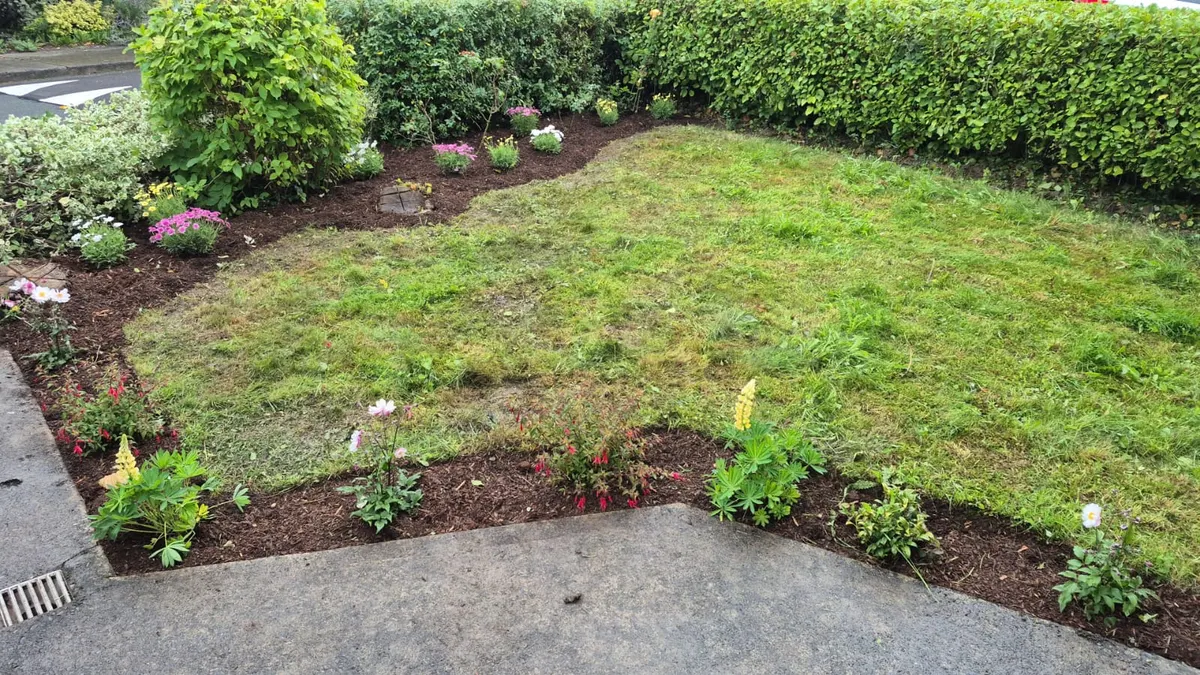
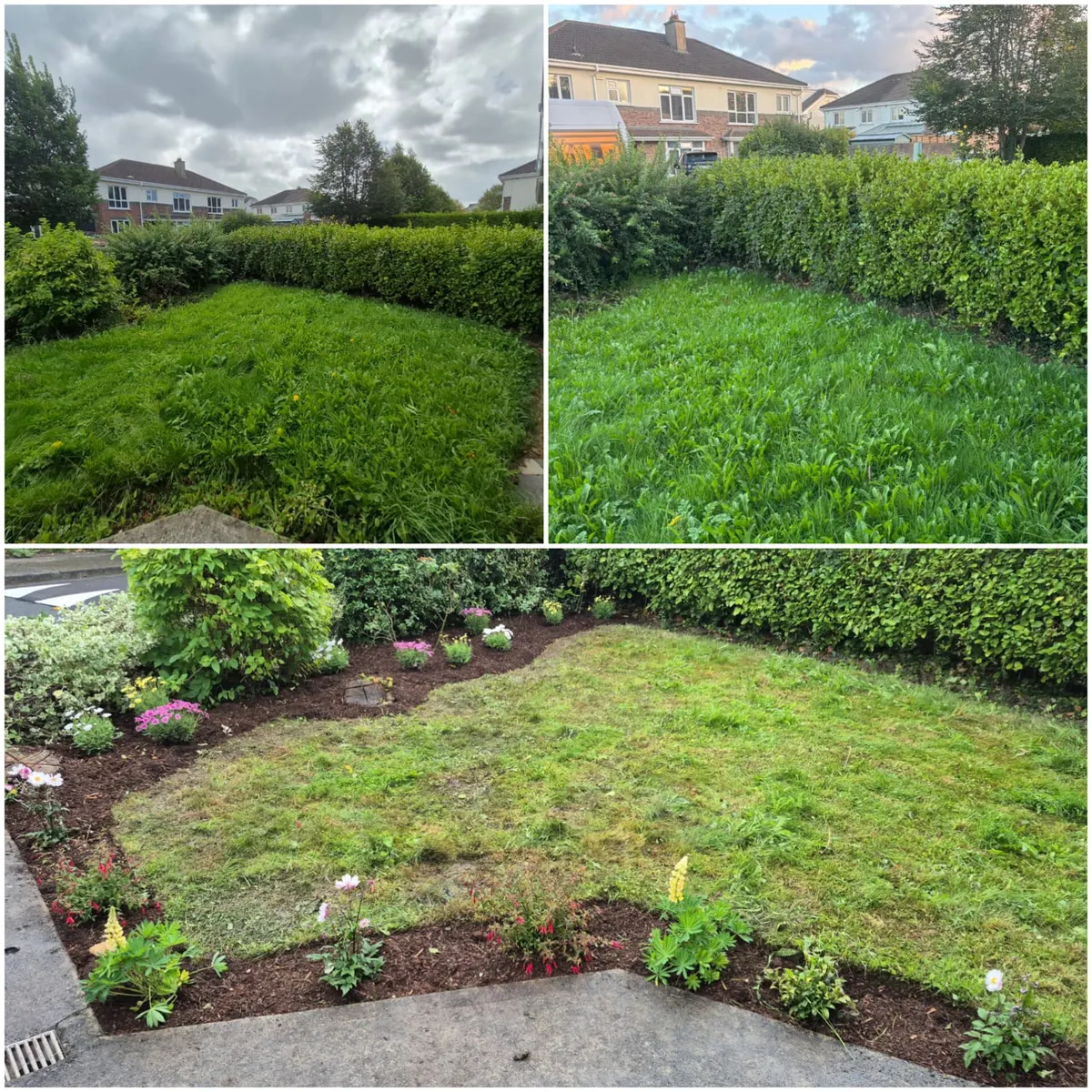
Seanie McMahon runs Kildare Plant & Garden Solutions from Kilcullen and works across Kilcullen, Naas, Newbridge and the rest of County Kildare. For a wet garden he starts with a site visit rather than a price over the phone, looking at levels, access and where the water comes from, then sends a written quotation setting out what is included. Excavation, levels and drainage sit within the landscaping and groundworks service. The photos in this guide show a lawn he restored and a new planted border; they are not drainage jobs, and no drainage price from this page is his. If you would like him to look, get in touch.
Keep reading: a patio that stays wet and green: wash, reseal or relay.
Keep reading: laying a patio in an Irish winter, and what frost and rain actually stop.
Garden drainage in Kildare: common questions
Why is my lawn waterlogged in Kildare?
Usually a dense or compacted layer holds rain near the surface, or the water table rises after heavy rain. Teagasc treats these as two different problems with different fixes. Water arriving from a downpipe, drive or the road can also be the cause.
How much does garden drainage cost in Ireland?
Two Dublin contractor guides give about €40 to €80 per metre for a French drain and €500 to €1,500 for a soakaway, and one gives €1,500 to €3,500 for an average back garden. They are marketing guides, so ask whether VAT is included.
Will a soakaway fix a waterlogged lawn on clay?
Not always. A soakaway needs ground that can take the water, and clay or a high water table can leave it full. Ask how the ground was judged and where the water goes when it is full.
Is VAT charged on garden drainage work?
Revenue lists landscaping at a private dwelling at the reduced rate, currently 13.5%. Whether a particular job qualifies is for the contractor to confirm, so ask whether each quote includes VAT and at what rate.
Can I send my drain water onto the road?
No. Kildare County Council has told landowners to keep water and soil from running onto a public road, and not to block water draining from the road. Check the council's current wording.
Is aeration enough for a wet lawn?
Only if the problem is mild. Spiking and top dressing treat slow drainage, not standing water. A test hole after wet weather shows which you have.
What does Kildare Plant & Garden charge for drainage?
Seanie does not publish a drainage price. He looks at the site, agrees what is wanted and puts the price and what it includes in writing. The quotation is free, subject to the project and location.
Sources
Sources opened and checked on 26 October 2026. Contractor figures are marketing guides and are labelled as such.
- Lion Paving & Landscaping: How to fix a waterlogged garden in Dublin, French drain and soakaway ranges.
- Power Landscaping: How to fix a waterlogged garden in Dublin, French drain range and whole-garden range.
- Teagasc: Which drainage system works for you?
- Teagasc: Mole drain performance in a clay loam soil in Ireland (2015).
- Teagasc: Design and performance of land drainage systems.
- Farmers Journal: Kildare County Council notice to landowners on drains and roads, an older report.
- Kildare County Council: Infrastructure and Environmental Services (county development plan consultation), surface water management.
- gov.ie: Technical Guidance Document H, Drainage and Waste Water Disposal (2016 edition).
- Met Éireann: climate averages on data.gov.ie, Casement Aerodrome rainfall.
- Revenue: VAT rate for landscaping (private dwellings).
- Revenue: Current VAT rates, the 13.5% reduced rate.
- CCPC: Home improvement and building work disputes.