Neither one clearly lasts longer. Retailers quote 20 to 50 years for both, and none of the pages we found backs that with an independent test in Irish weather. What differs is the upkeep and the price. Porcelain is dense and needs little more than a brush and a wash. Sandstone costs less per square metre, is porous, and the sellers' own advice is to seal it every few years. So the real question is not which lasts, but which one you are willing to look after. This guide sets out what is known, what is only sales talk, and the sums.
The short version
If you want the lowest upkeep, porcelain. If you want the lowest price on the slab and like a natural, uneven stone look, sandstone. On lifespan, the honest answer is that nobody has published a head-to-head Irish test, so treat any "lasts 50 years" promise as an estimate and ask what stands behind it.
- Frost: both are sold as frost resistant. That is a claim about a product, so ask for the datasheet.
- Moss and algae: porous stone holds moisture, so shaded sandstone greens up faster. Dense porcelain gives moss less to grip, though it still grows on dirt that settles on top.
- Price: sandstone is usually cheaper to buy; the gap is small next to the groundwork.
- Upkeep: sandstone asks for sealing and regular cleaning. Porcelain mostly asks for cleaning.
What the sellers actually say
Almost every page that ranks for this question is a paving seller. That is fair enough, but it shapes what they say. One UK retailer gives sandstone 20 to 50 years and porcelain 30 to 50 years. Other sellers put both at 20 to 50. Irish retailers describe 20 mm porcelain as frost resistant and non-porous, and say it suits Irish winters, without printing the test result beside the claim. On sandstone, a UK seller advises sealing and re-sealing to resist staining and growth. Two sellers disagree on how often: every 2 to 3 years, or every 3 to 5.
Put those together and you get a fair picture, with a gap. Porcelain is denser and takes less looking after. Sandstone is porous and wants sealing. What is missing is anything independent that says how a particular slab behaves after twenty Irish winters. That depends on the product, the base and how it was laid at least as much as on the material name, which is why the checklist further down matters more than the label.
What Irish weather asks of a patio
Two things wear a patio outdoors: water that freezes in the stone, and damp that grows moss and algae. Kildare gets both, though not as hard as colder countries.
On frost, Met Éireann's published long-term averages list air frost on about 41 days a year at Casement Aerodrome, an inland station near the Kildare border, against about 24 at Dublin Airport on the coast. Check the dataset for the period you care about, because the averages shift between 30-year sets. The point holds: inland Kildare frosts more often than the coast, so a slab that absorbs water has more chances to freeze and flake. That is why water absorption matters. A slab that takes in almost no water has almost nothing to freeze.
On damp, the whole county is mild and wet enough for moss. Shade, a north-facing aspect and a patio that stays wet because it has no fall are what turn a patio green, whatever it is made of. A patio laid without a fall away from the house will stay wet and green in either material.
Porcelain and sandstone side by side
| Question | Porcelain | Indian sandstone |
|---|---|---|
| Slab price, material only | €45 to €55 or more a m² (Onlinetradesmen); €30 to €33 and €47.99 (Farmers Journal) | €35 to €40 a m² (Onlinetradesmen) |
| Seller's lifespan claim | 30 to 50 years, unsourced | 20 to 50 years, unsourced |
| Frost | Sold as frost resistant; ask for the datasheet | Sold as frost resistant; ask for the datasheet |
| Moss and staining | Dense and non-porous, so less to grip and easier to wash | Porous, so holds damp and marks; sellers advise sealing |
| Upkeep | Brush and wash | Brush, wash and re-seal every 2 to 5 years on sellers' advice |
| Look | Even colour; some imitate stone | Natural variation in colour and surface |
| Laying | Needs the right adhesive or primer and careful jointing | Bedded and jointed conventionally; uneven thickness needs care |
The upkeep sum: what sealing adds over 30 years
Take a 20 m² patio and a 30-year horizon. Sellers advise re-sealing sandstone every 2 to 3 years, or every 3 to 5. Count the jobs.
| Sealing interval | Sum | Re-seals in 30 years |
|---|---|---|
| Every 2 years | 30 ÷ 2 | 15 |
| Every 3 years | 30 ÷ 3 | 10 |
| Every 5 years | 30 ÷ 5 | 6 |
Now the slab price gap on the same 20 m². Porcelain at €45 to €55 against sandstone at €35 to €40 is a difference of €5 to €20 a square metre, which is about €100 to €400 on 20 m². Sandstone saves that on day one. Against it sit between 6 and 15 rounds of cleaning, drying and sealing over the years, each one a weekend of work or a bill. We have not put a price on a re-seal because no Irish source gives one, so ask any sandstone quote what a professional re-seal costs and add it up yourself. If the answer times six to fifteen is more than a few hundred euro, the cheaper slab is not the cheaper patio. If you will do it yourself and enjoy it, it may be.
VAT on the job
Revenue lists landscaping at a private dwelling, including laying paths and patios, at the reduced rate, currently 13.5%, where the contractor is VAT registered. See the Revenue page on landscaping (private dwellings). Shop prices usually include VAT, and published ranges often do not say.
| Line | Amount |
|---|---|
| Illustrative quote, before VAT | €4,000 |
| VAT at 13.5% | €540 |
| Total including VAT | €4,540 |
The slab choice moves that total by a few hundred euro. The dig, base and edging move it by thousands, which is covered in our guide to what a patio costs in Naas. Where the contractor supplies the materials, Revenue's two-thirds rule decides which rate applies, so ask the contractor how the quote has been split.
What to ask any supplier for before you buy
This is the most useful part, because it turns a label into a fact. Ask for the manufacturer's datasheet for the exact product and look for these.
- Water absorption
A percentage. The lower it is, the less water there is to freeze in the slab. One Irish retailer guide says porcelain under 0.5% suits freezing winters; check the figure on the datasheet for your own product, not the guide.
- A frost test result
Not the words "frost proof", but a test and a pass. For natural stone, the standard for external paving slabs is EN 1341; for porcelain, the tile standard is EN 14411.
- Slip resistance
A rating, since a wet patio on a path to the door has to grip. Some retailers publish an R rating; ask what it was tested on.
- Thickness
Many Irish suppliers sell 20 mm porcelain for patios. Ask whether the thickness suits how it will be laid.
- Laying instructions
The adhesive, primer and jointing the maker specifies, because porcelain is not bedded the way sandstone is.
- For sandstone, the sealer and its interval
Which product, how often, and who does it.
Choosing a material?
Have Seanie price your patio
He will look at the levels and access, agree what is included and write the price down so you can compare like with like.
Request a free quoteCall 087 355 4302Which to choose: a decision table
This uses only the facts on this page.
| Your situation | Leans towards | Why |
|---|---|---|
| You want the least upkeep | Porcelain | Dense and non-porous, no sealing advised |
| A shaded or north-facing garden | Porcelain, with a proper fall | Porous stone holds damp where moss thrives |
| Lowest slab price and a natural look | Sandstone | €35 to €40 a m², a few hundred euro less on 20 m² |
| You will reseal it yourself | Sandstone | Upkeep is a job you control |
| Inland site with frequent frost | Either, if the datasheet shows low absorption | Frost risk depends on the product, not the name |
| Unsure | Ask for datasheets on two products | The paper settles it faster than the label |
Laying matters as much as the slab
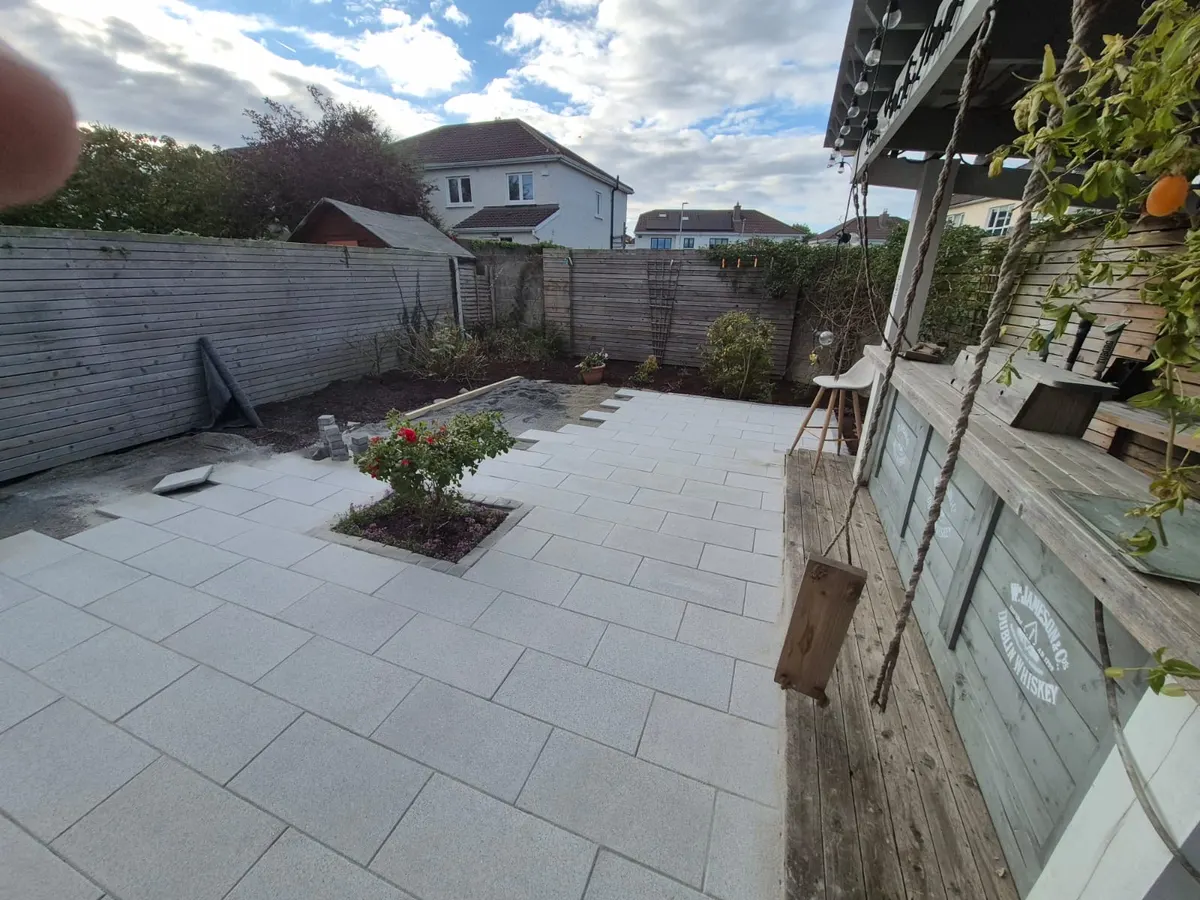
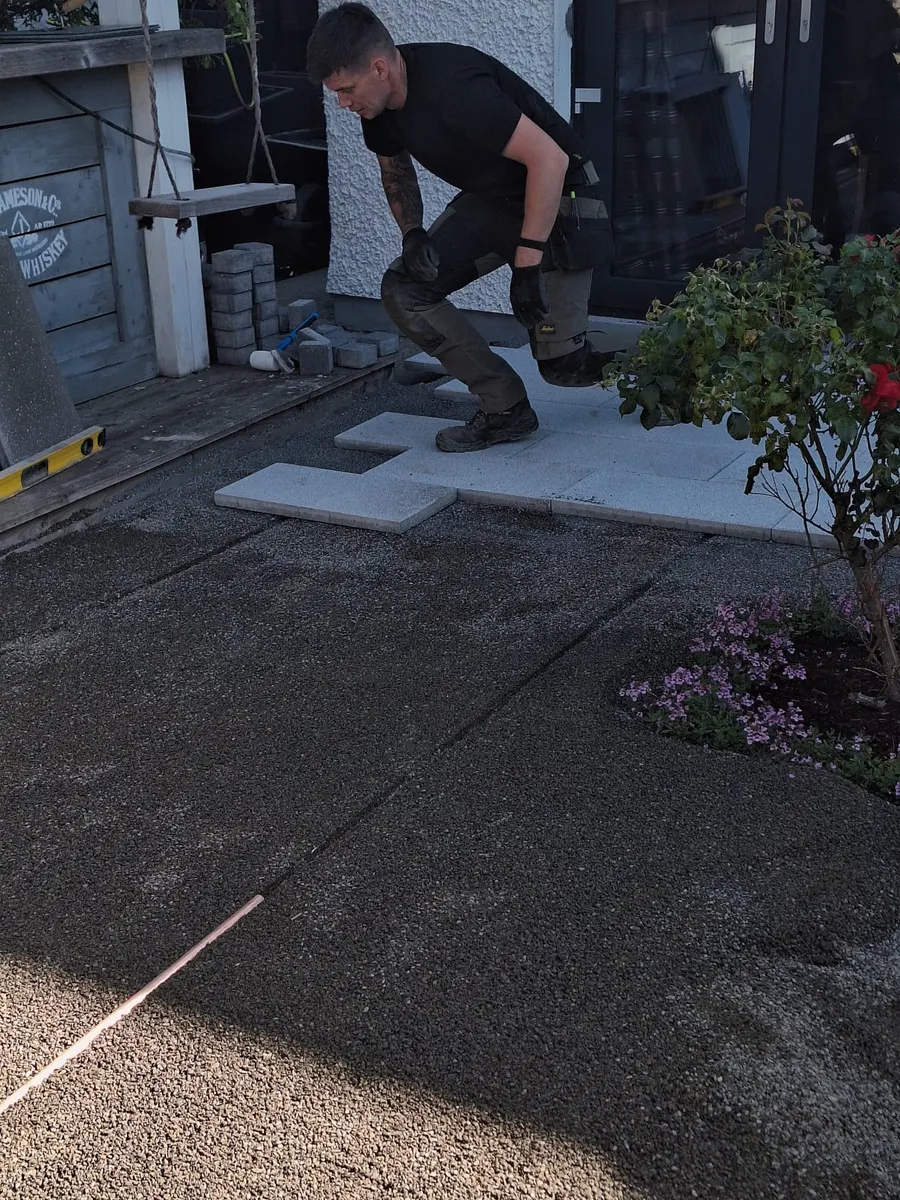
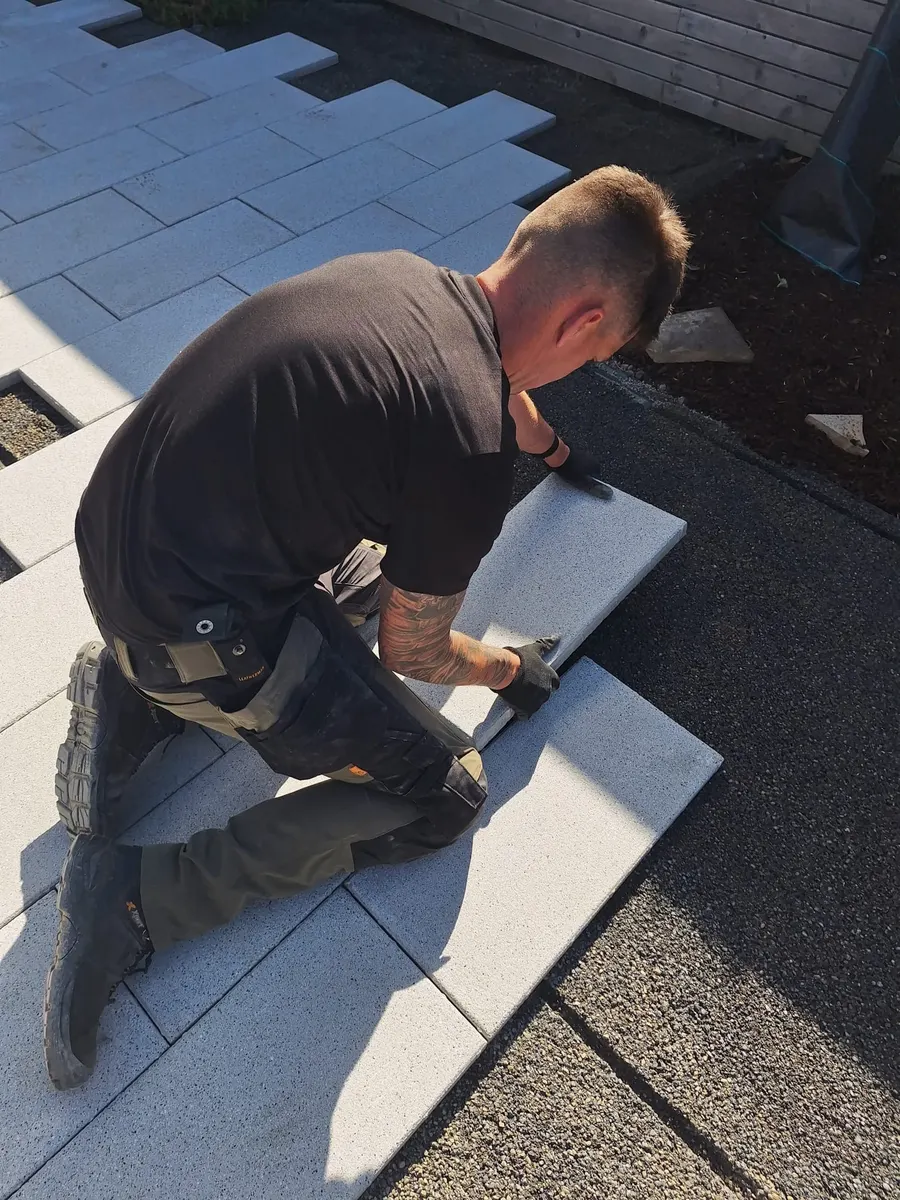
A good slab on a poor base fails sooner than a plain slab on a good one. The base, the fall away from the house and the jointing decide most of what you will see in ten years, in either material. The photos in this guide show a porcelain patio job by Seanie: the bedding layer, laying the slabs and the finished patio. We do not have a sandstone job to show, so we do not claim to compare the two on site. If a patio is part of a wider change to the garden, see garden transformations, and for levels and drainage first, read about a garden after an extension.
Do you need planning permission?
For a hard surface behind the house, usually not. Class 6 of Part 1 of Schedule 2 to the Planning and Development Regulations 2001, as amended in 2011, exempts a hard surface to the rear of a house used for ordinary enjoyment of it. The material does not change that. In a front or side garden there are size and drainage conditions, and an estate with planning conditions, a conservation area or a protected structure can differ. Ask Kildare County Council if unsure, before paying a deposit.
What a quote should say
- The product by name
Brand, size, thickness and finish, not "porcelain" or "sandstone".
- The base and the fall
Depth of dig, sub-base and where the water goes.
- Sealing, for sandstone
Whether the first coat is in the price and the plan after.
- Waste and spoil
Whether taking away what comes up is included.
- VAT
Whether the price includes it, and whether the business is registered.
- Insurance
Whether public liability cover is held. Ask to see it.
Services sold since 29 November 2022 are covered by the Consumer Rights Act 2022, explained by the Competition and Consumer Protection Commission in its guidance on selling services. A written scope makes any complaint easier to settle.
How Kildare Plant & Garden approaches a patio
Kildare Plant & Garden Solutions is based in Kilcullen and works across Naas, Newbridge and the county. Seanie does not publish a price per square metre, because the dig, the levels and the access decide the price more than the slab does. He looks at the site, agrees what is wanted and puts the price in writing, with what is included. The quotation is free, subject to the project and location.
To start, send your town, the rough size and a few photos through the contact page, or read about patios and paving first.
Keep reading: what a garden makeover costs in Kildare, at three budget levels.
Keep reading: a green or slippy patio: wash, reseal or relay.
Keep reading: decking or patio in Kildare, cost, lifespan and upkeep side by side.
Porcelain or sandstone: common questions
Which lasts longer, porcelain or sandstone?
Sellers quote 20 to 50 years for both, and none of the pages we found backs that with an independent Irish test. How long a patio lasts depends on the product, the base and the laying as much as the material.
Is porcelain better for Irish weather?
It needs less upkeep, because it is dense and non-porous, so there is less to freeze and less for moss to grip. Both are sold as frost resistant, so ask for the datasheet showing water absorption and a frost test.
Does sandstone need sealing?
Paving sellers advise sealing it, with re-sealing every 2 to 3 years or every 3 to 5, depending on the seller. Ask any sandstone quote who seals it and what a re-seal costs.
Is sandstone cheaper than porcelain?
Usually, for the slab. Onlinetradesmen gives €35 to €40 a square metre for Indian sandstone and €45 to €55 or more for porcelain, a gap of roughly €100 to €400 on 20 m². The groundwork costs more than the difference.
Will a porcelain or sandstone patio go green?
Either can, in shade or where water sits. A patio laid with a proper fall away from the house stays drier. Porous sandstone holds damp more, so it greens sooner if it is not sealed and cleaned.
Is VAT charged on a patio in Ireland?
Yes, when the contractor is VAT registered. Revenue lists landscaping for private dwellings, including patios, at the reduced rate, currently 13.5%. Ask whether each quote includes it.
What does Kildare Plant & Garden charge for a patio?
Seanie does not publish a price per square metre. He looks at the site, agrees what is wanted and puts the price and what it includes in writing. The quotation is free, subject to the project and location.
Sources
Checked on 23 October 2026.
- Met Éireann: climate averages on data.gov.ie, air frost days at Casement Aerodrome and Dublin Airport.
- Revenue: VAT rate for landscaping (private dwellings).
- Revenue: Current VAT rates.
- Revenue: Services taxable at the rate of the goods (the two-thirds rule).
- Irish Statute Book: S.I. 454 of 2011, amending Class 6 (hard surfaces) of the Planning and Development Regulations 2001.
- Competition and Consumer Protection Commission: Selling services.
- Onlinetradesmen: Patio paving ideas price guide, slab price ranges, 2025.
- Farmers Journal: Groundcare, patio paradise, porcelain slab prices, 13 March 2024.
- Royale Stones: Outdoor paving, an Irish seller's description of 20 mm porcelain.
- Universal Paving: How to seal Indian sandstone, a UK seller's sealing advice, sterling prices not used.